
|

|

|

|

|

|

|
|
|
|
|
|
|
One of the most visually interesting aspects of Cliff Art is the odd choice of instruments.
Here is Cliff Art performing at a wedding (no, really) and you can get a pretty good sense of the instruments (that is the dulcimer that is on the stand in front of Cliff) and even see some of the electronics. Fortunately, the amount of electronic gadgetry has been much reduced since this picture was taken (22 May 1999).
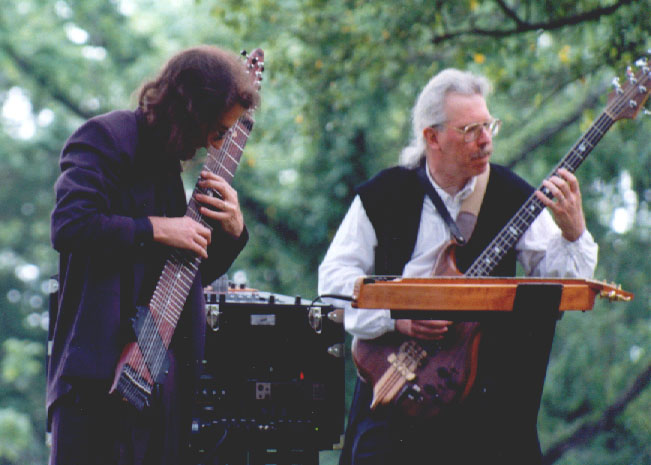
The Appalachian lap dulcimer is a primitive instrument whose name gives away a lot about it. It was used extensively by the people of the Appalachian region of the Eastern United States. The original way it was played was to be placed on the performer´s lap with the strings running perpendicular to the performer´s thighs and the tuning pegs to his/her left. The strings were then strummed with the right hand and the notes were picked out using a wooden dowel in the left hand.
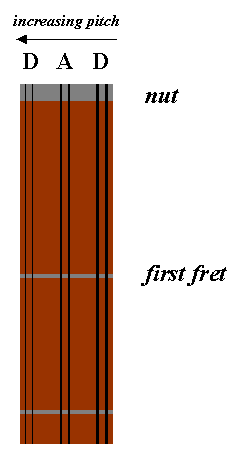
As with many primitive instruments, it is tuned to a particular key, so that songs in that key are relatively easy, but songs outside that key are nearly impossible. Cliff´s dulcimer is tuned to D major, in fact, the frets are placed "diatonically" so that they describe the key of D major. In other words, the first fret is not a D#, but is an E instead (the major 2nd of the key). Cliff does not use a dowel to pick out the notes, but fingers them like a guitar instead.
Here is the tuning of the dulcimer that Cliff uses:
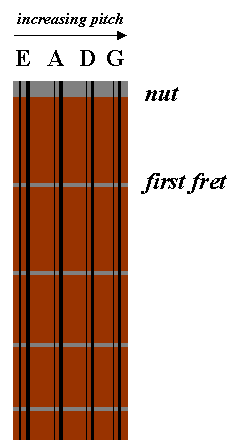
The eight-string bass is really just a four-string bass with each string doubled. One string is tuned in the same range as a "normal" four-string bass, while the other of the doubled strings is tuned one octave higher. The result is a very bright and big sound. This is very similar to the 12-string guitar, which you might recognize from "Turn, Turn, Turn" by The Byrds.
Cliff has both an electric and acoustic 8-string bass. The electric is made by Alembic, while the acoustic was a custom job by Dave Maize.
(trademark disclaimer)
Here is the tuning of the bass that Cliff uses:
Chapman Grand StickTM (trademark disclaimer)
The Chapman StickTM is a modern instrument that grew out of the guitar family of instruments. The Stick is designed to be tapped using the tips of the fingers on both hands at once, much like tapping the keys of a piano.
What does it look like? The instrument looks like a very wide fretboard from a guitar except that there is no guitar body. Sometimes, the group describes the instrument as a guitar that has been run through an old ringer washer, resulting in a long thin guitar.
The usual set-up for a Stick, is to have two "sides"; a high side (also called the melody side) and a low side (also called the bass side). Each side, is a complete equal set of strings. In Stuart´s case there are six strings on each side. (Stuart´s Stick is called a "Grand" Stick. There are other models with fewer strings.)
The instrument is worn in a manner much different from a guitar or bass. To wear the Stick, there is a belt hook on the back, near the bottom. Simply hook that into your belt and you are half-way there. The top is kept more or less vertical (and somewhat parallel to your body) by a strap attached to the side of the neck just below the tuning pegs (the head).
When worn normally, the high/melody side is farthest from the performer´s face, while the low/bass side is closest to the performer´s face. During performance, the hands cross over the instrument; the high/melody side is intended to be played with the right hand, while the low/bass side is intended to be played with the left hand.
The high/melody side is tuned in straight fourths, while the low/bass side is tuned in perfect fifths. The result is that the tunings are "mirrored". Any position performed on one side of the Stick can be reversed on the other side.
Stuart uses heavy guage strings and follows the "standard" tuning:
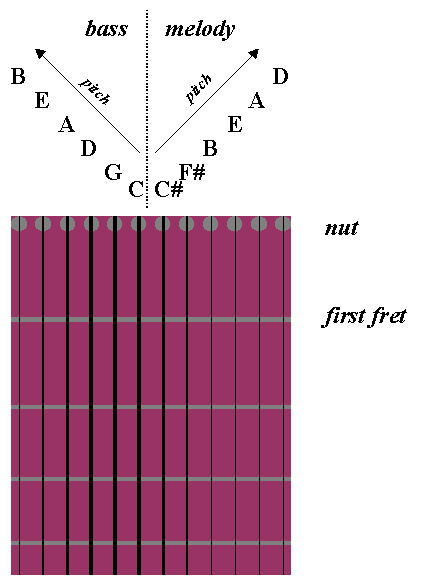
Note that the tuning of the low/bass side carries the same note names as a six-string bass. However, the note frequencies are in reverse, where, on the Stick, B is the highest bass string and C is the lowest bass string.
If you have ever heard of Stanley Jordan, they you have a good idea of the type performance technique used on the Stick. However, the Stick has some features that make tapping more effective:
Basically, the Stick is very easy to play.
For more information, you can visit the official Chapman Stick web site.
Dave plays a whole bunch of drums. When Dave sits in, Cliff and Stuart can no longer keep track of his rig, but it awesome to behold.
(trademark disclaimer)
Once upon a time, Cliff had a very complicated signal chain that all started with an Alembic F-2B pre-amp and just going through more and more stuff until it reached a Roland amplifier.
These days, it is impossible to keep track of Cliff´s chain. It usually changes from gig to gig. If you are interested, you should probably just show up and find out what he is doing for that gig.
We can say that, at various times, Cliff has used a small Mackie mixing board (about six channels), a small Gallien-Krueger bass amplifier, and any number of other pieces of equipment from other manufacturers. In fact, to get an idea of the type of equipment used by Cliff, just go to your local music store and look around. He probably used one of whatever you see.
(trademark disclaimer)
Stuart's signal chain was in a stable configuration for years, meaning that it was housed with the livestock... nobutseriouslyfolks... After years of using the same basic equipment, Stuart decided that there was just too much noise in the signal, so something needed to be done. The obvious solution was a whole new rack of equipment; half of it borrowed from Cliff.
Because each side of the Stick requires individual signal processing, Stuart begins his signal chain with a stereo volume pedal, which allows him to run each side of the Stick into two separate pre-amps in one unit: the Alembic F-2B (borrowed from Cliff). The F-2B can process two completely separate channels and it is incredibly simple to use, so it is a favorite of both Cliff and Stuart.
Each channel of the F-2B preamp is run into a separate effects processor. These two effects processors are identical "G-Force" units from TC Electronic.
The outputs of these two TC G-Force units are brought together in a direct box, which is then fed into two JBL Eon 10s, which are run in serial.
(trademark disclaimer)
One of these days, Stuart will make good on his threat to get a raunchy distortion pedal. If anyone has any suggestions, Stuart would be willing to hear them so email him some ideas!
The trade names of all equipment listed on this page are to be considered the legal property of the companies manufacturing and doing business under those names. The names covered by this disclaimer include, but are not limited to (in alphabetical order by corporation):
"Cliff Art" and the Cliff Art logo are trademarks of CliffArtifacts
